
‘By now, we take this merit for granted. New generations have not had to experience the bureaucracy and inconvenience that preceded the digital age. We are the only country in the world that uses a digital identity guaranteed and secured by the state, where people are used to using digital services, and where there is a high level of trust, thanks to which we have been able to conduct e-voting, for example, since 2005,’ added Erlich.
‘Estonian people depend on digital services and it is very important that we acknowledge the dangers that come with the convenience. The security vulnerability discovered on the ID-card chip in 2017 and the inconveniences associated with updating the cards gave us a good lesson and highlighted the clear need for alternatives. If something happens to one tool, it must be possible to use another. Therefore, the number of mobile-ID users has increased by half since 2017 and the number of Smart-ID users has tripled,’ added Erlich.
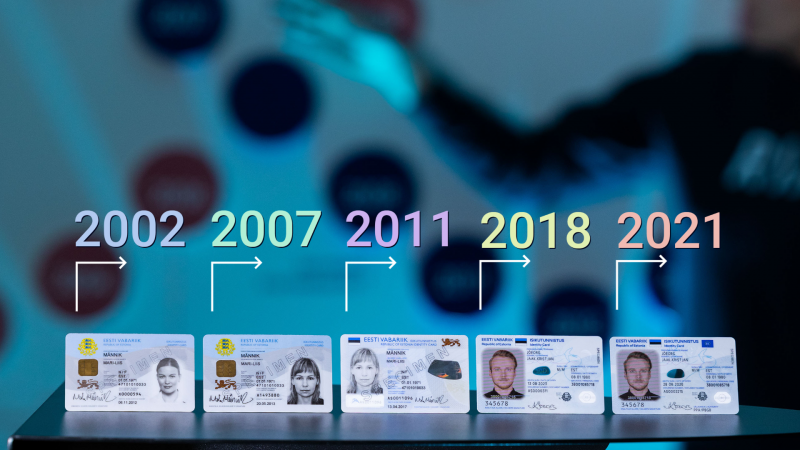
During the twenty years, five ID-cards with different designs have been in use. The biggest visual changes can be seen in the cards that the Estonian Police and Border Guard Board started issuing at the end of 2018.
‘Estonian nature and national elements, such as the Estonian coat of arms, the national bird the barn swallow, and boulders, play an important role in the design of ID-cards. When looking at the ID-card in UV light, national motifs and the image of a lynx living in our forests become visible,’ described Eliisa Sau, Chief Expert of the PBGB Identity and Status Bureau. Sentences describing the special nature of Estonia are also written on the ID-card in small print. For example: ‘Estonia has diverse national parks and exciting protected areas, where nature, culture, and history are closely intertwined. For a small area, the diversity of our landscapes is unique in Europe.’
The most convenient and affordable way is to apply for an ID-card through the self-service portal of the Police and Border Guard Board – 45% of all ID-card applicants use this option. ‘To apply for a document, you must first go to the website www.politsei.ee/en/self-service-portal. If you have the proper photo, specimen signature, and fingerprints, you can apply for the document with just a few clicks. If you do not have the necessary photo, signature, or fingerprints, you can get them free of charge in the digital kiosk of the service office, from where the data is automatically transferred to the self-service web environment, where a document application can be submitted by logging in again,’ said Sau.
The first 174 ID-cards were ceremoniously handed over on 28 January 2002 in the Old Town studio in Tallinn, and the first document was received by President Arnold Rüütel. In 2002, 117,609 ID-cards were issued.
The ID-card and electronic ID in numbers
- 4.06 million ID-cards issued (including ID-cards for 57,900 EU citizens and 350,000 foreigners)
- 1.49 million ID-cards in use
- 12.5 million ID-card transactions per month
- 3 million digital signatures per month
- 200,000 active ID-card users (electronically)
- 54.7% of voters vote electronically (ID-card or mobile-ID)
- 251,000 mobile-ID users
- 615,000 Smart-ID users

